PRINTING TECHNIQUES
There are many printing techniques that have developed throughout history, each with its own processes and results. In the workshop, we have the possibility to offer several. Here we briefly explain some of the most well-known and used in printing today.
INTAGLIO TECHNIQUES
DRYPOINT

Drypoint is a calcographic printing technique in which one draws directly on a metal plate scratching its surface.
A sharp, pointed tool, the drypoint, is used, which gives the technique its name. When the plate is inked, the ink is deposited in the incisions made previously. One of its most distinctive characteristics is the velvety line it produces, with great expressive richness. Currently, plastic plates can also be used, which offer similar results and constitute a more economical alternative.
ETCHING

Etching is an indirect technique that uses the action of an acid or mordant to engrave the image onto the plate.
The plate is degreased and covered with a protective varnish and left to dry. It is drawn on with a point over this varnish, leaving the metal exposed. When the plate is submerged in acid, it only etches the exposed lines, creating grooves that subsequently hold the ink. Finally, the varnish is cleaned off, the plate is inked, and it is printed onto paper.
Unlike the drypoint, the line of the etching is fine, sharp and precise. This technique allows for very detailed images.
AQUATINT

Aquatint allows for tonal values and stain surfaces.
The plate is covered with a fine layer of powdered resin that, through heat, adheres to the metal and creates a uniform pattern of dots with exposed plate areas. The resin particles act as a reserve and the corrosive action of the acid affects the small exposed dots, generating a surface capable of holding the ink. By varying the exposure times to the acid, lighter or darker tones can be achieved.
With varnish, reserves can be made in those parts that are not to be etched and will therefore remain completely white. It is a very versatile technique and is often combined with etching to enrich the images.
Aquatint is the basis of other techniques, such as sugar-lift, spit bite or soap-ground.
SOFT VARNISH
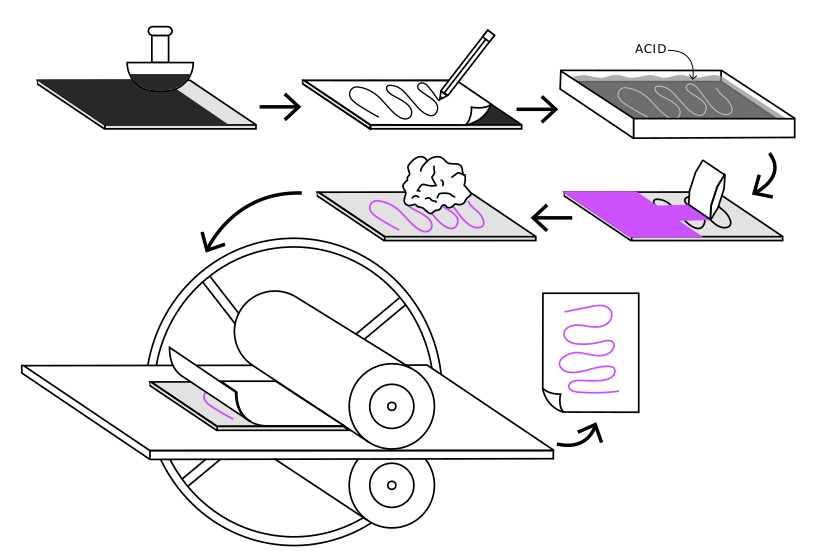
Soft varnish is an indirect technique that uses the acid or mordant to etch the image onto the plate.
The plate is covered with a varnish that, unlike that used for etching, does not dry completely. A lightweight paper is placed over the plate and drawn on with a pencil. The pressure of the pencil causes the varnish to adhere to the paper and leave areas of metal exposed. The plate is submerged in acid, which acts on these exposed areas. Once the varnish is removed, the ink is retained in the areas where the incision has occurred.
The result is a very similar effect to the pencil stroke. With this technique, textures can also be achieved or records and marks of various materials can be produced.
RELIEF TECHNIQUES
WOODCUT

Woodcut is a relief printing technique that uses a wood matrix.
The image is drawn on the wood and carved with gouges. The carved areas will remain white, while the raised parts that have not been hollowed out will receive the ink. The plate is inked with a roller and printed on the press. Manual printing systems, such as the baren, can also be used.
With this technique, flat and uniform inks can be achieved, but the inherent texture of the wood can also be utilized. Different types of wood can be used, which will directly influence the final result and the carving process of the matrix.
LINOCUT
Linocut is a relief printing technique that uses a matrix of linoleum.
The image is drawn on the linoleum and the surface is carved with gouges, removing the parts that will remain white. The raised parts are inked with a roller and printed on the press.
With this technique, clean and defined lines, great contrasts, and homogeneous backgrounds can be achieved thanks to the surface of the linoleum. This is a material softer than wood and can offer advantages in the image cutting process.
SCREEN PRINTING
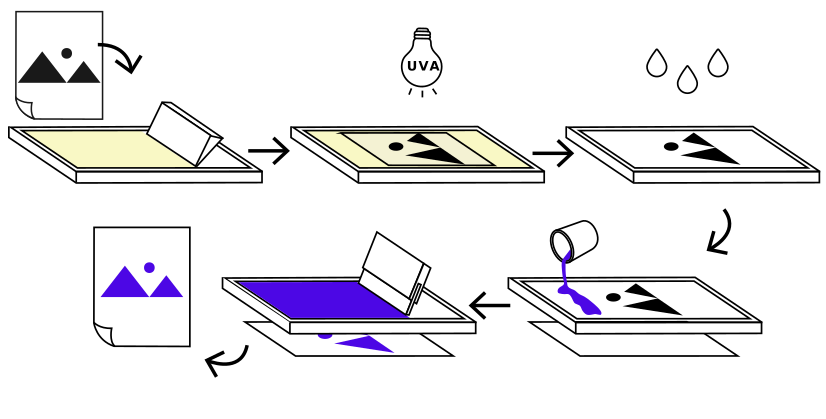
Screen printing is a printing technique that uses a mesh screen as a matrix.
The image is transferred to the screen, blocking the areas where ink is not wanted to pass. With a squeegee, the ink is pressed through the open parts of the mesh and printed onto paper, fabric, or other surfaces.
Amb aquesta tècnica es poden aconseguir colors intensos i uniformes, contorns definits i estampacions sobre una gran varietat de materials.
PHOTOPOLYMER
(Coming soon available at the workshop)